
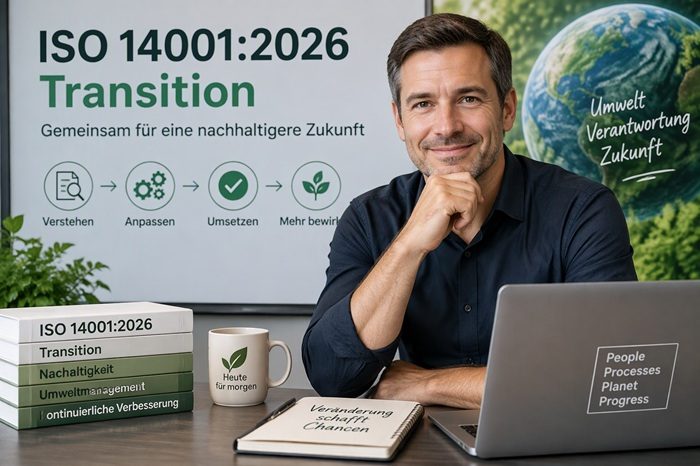
Your business has spent years building an environmental management system. Employees understand their responsibilities, environmental risks are assessed and internal audits help keep operations on track. Then ISO 14001:2026 is published and a familiar question starts circulating through management meetings. Does everything need to be updated or will the business have to start again?
For organisations already certified to ISO 14001:2015, the concern is understandable. Developing an environmental management system takes time and maintaining it requires ongoing attention. Nobody wants to replace procedures, retrain employees and create new documents unless those changes are genuinely necessary.
The encouraging news is that ISO 14001:2026 does not require organisations to discard an effective existing system. The revised standard builds on the previous edition while clarifying requirements relating to environmental conditions, planning, leadership and performance.
However, businesses cannot assume that an existing certificate or a successful previous audit means their system automatically meets the revised requirements. Understanding what has changed and where existing processes may need improvement is the starting point for a successful transition.
Why Has ISO 14001 Changed After More Than a Decade?
ISO 14001:2015 established a widely used framework for managing environmental aspects, compliance obligations and environmental performance. Its fundamental principles remain relevant but the circumstances in which organisations operate have continued to evolve.
Consider an Australian manufacturer that relies on consistent access to water, electricity and raw materials. Environmental management is not limited to controlling waste from production. Changes in resource availability, environmental conditions and supplier operations may also affect the organisation’s ability to operate effectively.
ISO 14001:2026, published on 15 April 2026, reflects a broader understanding of these connections. It places clearer emphasis on environmental conditions such as climate change, biodiversity, ecosystem health, pollution and the availability of natural resources.
The revision also strengthens the connection between environmental management and business decisions. Rather than focusing primarily on whether procedures exist, organisations need to demonstrate how their systems support environmental objectives and measurable performance.
For businesses already operating an effective environmental management system, this is more of a refinement than a complete change in direction.
What Has Actually Changed in ISO 14001:2026?
The updated standard retains the familiar structure of environmental management, including leadership, planning, operational controls, performance evaluation and continual improvement. However, several areas deserve closer attention.
Environmental Conditions Need Broader Consideration
Climate change was already addressed through the 2024 amendment to ISO 14001:2015. The 2026 edition builds on this by providing clearer consideration of environmental conditions that may affect the organisation or be affected by its activities.
For example, a construction business may need to consider how its operations interact with local environmental conditions. A manufacturer may need to assess whether resource availability or changing environmental circumstances could influence its activities.
This does not mean every organisation must introduce separate programmes covering every environmental issue. The requirement is to determine what is relevant to the business and consider those matters appropriately within its management system.
Planning Risks and Opportunities Is More Clearly Defined
The revised standard provides a clearer structure for determining risks and opportunities and planning actions to address them. These principles existed in ISO 14001:2015 but their organisation and presentation have been refined.
A business may already maintain an environmental risk register that identifies significant environmental aspects and related concerns. The transition provides an opportunity to check whether those assessments remain relevant and whether identified risks and opportunities lead to suitable actions.
Simply listing an environmental concern is not the same as managing it. Organisations should be able to demonstrate how relevant findings influence decisions, controls and environmental objectives.
Changes to the Management System Must Be Planned
One notable addition is Clause 6.3, which addresses planning changes that affect or could affect the environmental management system.
Imagine a manufacturing business introducing new equipment that uses different materials and produces additional waste. The organisation should consider whether the change affects its environmental aspects, controls or compliance obligations.
Businesses may already have procedures for reviewing operational changes. Where those processes adequately address environmental management requirements, they may only need refinement rather than replacement.
Environmental Responsibilities Extend Beyond Direct Operations
ISO 14001:2026 also clarifies expectations concerning externally provided processes, products and services. The intention is to help organisations consider relevant environmental aspects beyond activities performed directly by their own employees.
For example, a business purchasing materials from external suppliers may need to consider environmental aspects associated with those products where it can exercise control or influence.
This does not mean an organisation becomes responsible for controlling every supplier activity. The focus remains on identifying relevant environmental aspects and applying suitable controls or influence within the organisation’s circumstances.
Can Your Existing Environmental Management System Stay?
For many certified businesses, the answer is yes. Much of the existing environmental management system may remain suitable provided it meets the updated requirements and continues to operate effectively.
Environmental policies, operational procedures, monitoring arrangements, training records and internal audit processes do not automatically become obsolete because a new edition has been published.
The important question is whether those processes still address the organisation’s actual environmental responsibilities.
Consider two businesses with environmental aspects registers. One reviews its register regularly and updates it whenever operations change. The other has used the same register for years despite introducing new equipment, suppliers and services.
Both have documentation but only one may have a process that properly reflects its current activities.
This is why transition preparation should begin with reviewing existing arrangements rather than rewriting everything. A gap analysis can help distinguish between processes that remain suitable and those requiring improvement.
Will Your Existing ISO 14001:2015 Certificate Remain Valid?
The publication of ISO 14001:2026 does not immediately invalidate certificates issued against ISO 14001:2015.
A transition period allows certified organisations to update their management systems and complete the required assessment. Existing certificates can remain valid during this period provided they continue to meet the applicable certification requirements and have not otherwise expired, been suspended or withdrawn.
The transition period runs until April 2029. Organisations should complete their transition before May 2029 to maintain certification under the revised standard.
This distinction is important for businesses that rely on certification for supplier assessments or contractual requirements. A certificate may have an expiry date printed on it but that does not necessarily mean certification against the previous edition will remain recognised beyond the transition deadline.
Businesses should confirm their individual transition arrangements with their certification body and avoid assuming that the printed certificate expiry date is the only deadline that matters.
Will You Need Another Audit for ISO 14001:2026?
Yes. Organisations seeking to maintain accredited certification will need their management systems assessed against the revised requirements by their certification body.
However, this does not necessarily mean repeating the entire initial certification process.
Depending on the certification body’s arrangements, the transition assessment may be conducted during a scheduled surveillance audit, a recertification audit or a separately arranged assessment.
The auditor will need evidence that relevant changes have been implemented and that the management system meets the updated requirements.
For example, if the organisation has revised its approach to environmental context or planning changes, it should be able to demonstrate how those arrangements operate in practice. Updated procedures alone may not provide sufficient evidence if employees are unfamiliar with the changes or the processes have not been implemented.
The certification body can explain the assessment arrangements and any additional audit time required.
What Happens If Your Business Misses the Transition Deadline?
Missing the transition deadline can have consequences for certificate
ion status.
After the transition period ends, certification to ISO 14001:2015 will no longer remain valid under the applicable transition arrangements. An organisation that has not completed the required assessment may therefore lose its recognised certification status.
This could create difficulties where customers or contractual arrangements require current ISO 14001 certification.
The business may also need to complete additional certification activities to regain recognised status. The exact process will depend on the circumstances and the certification body’s requirements.
For organisations that rely on certification when responding to tenders or demonstrating supplier eligibility, allowing the transition deadline to pass without a plan could create avoidable complications.
Preparing early is therefore not simply about avoiding an audit problem. It helps protect continuity in how the business demonstrates its environmental management arrangements.
What Should Businesses Update First?
A practical transition should begin with understanding the revised requirements rather than immediately changing documents.
Management can start by obtaining ISO 14001:2026 and comparing its requirements with the organisation’s existing environmental management system. A gap analysis can then identify which arrangements remain suitable and where further work is required.
Environmental context and interested party considerations are useful areas to examine early. Businesses should also review how environmental aspects, compliance obligations, risks and opportunities influence their objectives and operational controls.
Next, the organisation should consider whether its processes for managing changes and externally provided activities adequately address the revised requirements.
Any necessary updates should be communicated to relevant employees. Some changes may require formal training while others may be addressed through operational meetings, revised instructions or targeted awareness activities.
Once changes have been implemented, internal audits and management reviews can help determine whether the updated system operates effectively.
The aim is to complete the transition through normal business processes wherever practical rather than treating it as an isolated documentation project.
How Much Time Should You Allow for the Transition?
There is no universal preparation period that applies to every organisation. A business with an established environmental management system, regular internal audits and effective operational controls may require relatively limited changes.
Another organisation may discover that its processes have not kept pace with changes in activities or environmental responsibilities.
The number of sites, complexity of operations, availability of employees and extent of required changes can all influence preparation time.
Businesses should also allow sufficient time to demonstrate implementation. Updating a procedure shortly before an audit may not establish that the process has been understood and followed.
It is sensible to coordinate preparation with the certification body’s audit schedule. This can help the organisation plan its gap analysis, implement necessary changes and complete internal verification before the transition assessment.
Does ISO 14001:2026 Mean More Paperwork?
Not necessarily. The revised standard does not mean every organisation needs a larger environmental manual or additional forms for every activity.
Consider a business that already evaluates environmental implications when approving operational changes. If the process meets the revised requirements and appropriate evidence is available, there may be no reason to introduce a separate approval system.
Similarly, an organisation may already monitor environmental objectives through existing management reports. Strengthening the information reviewed or the actions taken may be more useful than creating additional reporting documents.
Documentation should support the management system and provide necessary evidence. It should not become an administrative exercise disconnected from how the organisation operates.
Businesses should nevertheless ensure that required documented information is maintained and that their arrangements can demonstrate conformity with the revised standard.
Use the Transition to Improve Environmental Performance
It is tempting to approach ISO 14001:2026 as another certification task. Management could review the revised clauses, update a few procedures and prepare for the next audit without examining whether the environmental management system is delivering meaningful results.
That would overlook an opportunity to improve how environmental information influences business decisions.
Imagine a company that has monitored electricity consumption for several years. The data is collected and reviewed but rarely influences decisions about equipment, operating schedules or resource efficiency.
The transition provides an opportunity to examine whether environmental objectives are connected to practical actions and whether performance information is being used effectively.
The same principle applies to waste management, supplier selection, environmental risks and operational changes. A useful environmental management system should help the organisation understand its responsibilities and make informed decisions rather than simply demonstrate that required documents exist.
Keep What Works and Improve What Needs Attention
Moving from ISO 14001:2015 to ISO 14001:2026 does not generally require businesses to rebuild their environmental management systems from the beginning. The revised standard retains the established framework while providing clearer expectations around environmental conditions, leadership, planning, operational controls and performance.
For organisations with effective existing systems, much of the foundation can remain. The priority is to understand the updated requirements, identify genuine gaps and make changes that improve the way environmental responsibilities are managed.
Businesses should also plan for the transition assessment, confirm certification arrangements and allow sufficient time to demonstrate that changes have been implemented.
Ultimately, the transition should not be measured by how many documents an organisation rewrites. Its real value lies in ensuring that the environmental management system remains relevant, effective and capable of supporting better environmental decisions as the business continues to develop.